Pastoral Letters
WALKING TOGETHER – Archbishop Weekly Thoughts for Reflection from the Synod BUNBURY
Thursday 5 October, 2023 Dear Brothers and Sisters, As I write this letter to you, the members of the Synod on Synodality are coming to the end of our three-day retreat. We are staying in […]
WALKING TOGETHER – Archbishop Weekly Thoughts for Reflection from the Synod BUNBURY
Sunday, 24 September 2023 Dear Brothers and Sisters,As I write this message, I am on my way to Rome to take part in the Synod of Bishops. According to the“moving map” on the screen in […]
Pastoral Letter from The Most Rev Timothy Costelloe SDB DD Apostolic Administrator
Dear brothers and sisters in Christ, Grace and peace to you from God our Father and the Lord Jesus Christ (Phil 1:2) I hope you will forgive me for the formal greeting which opens this […]
Message from the Bishop
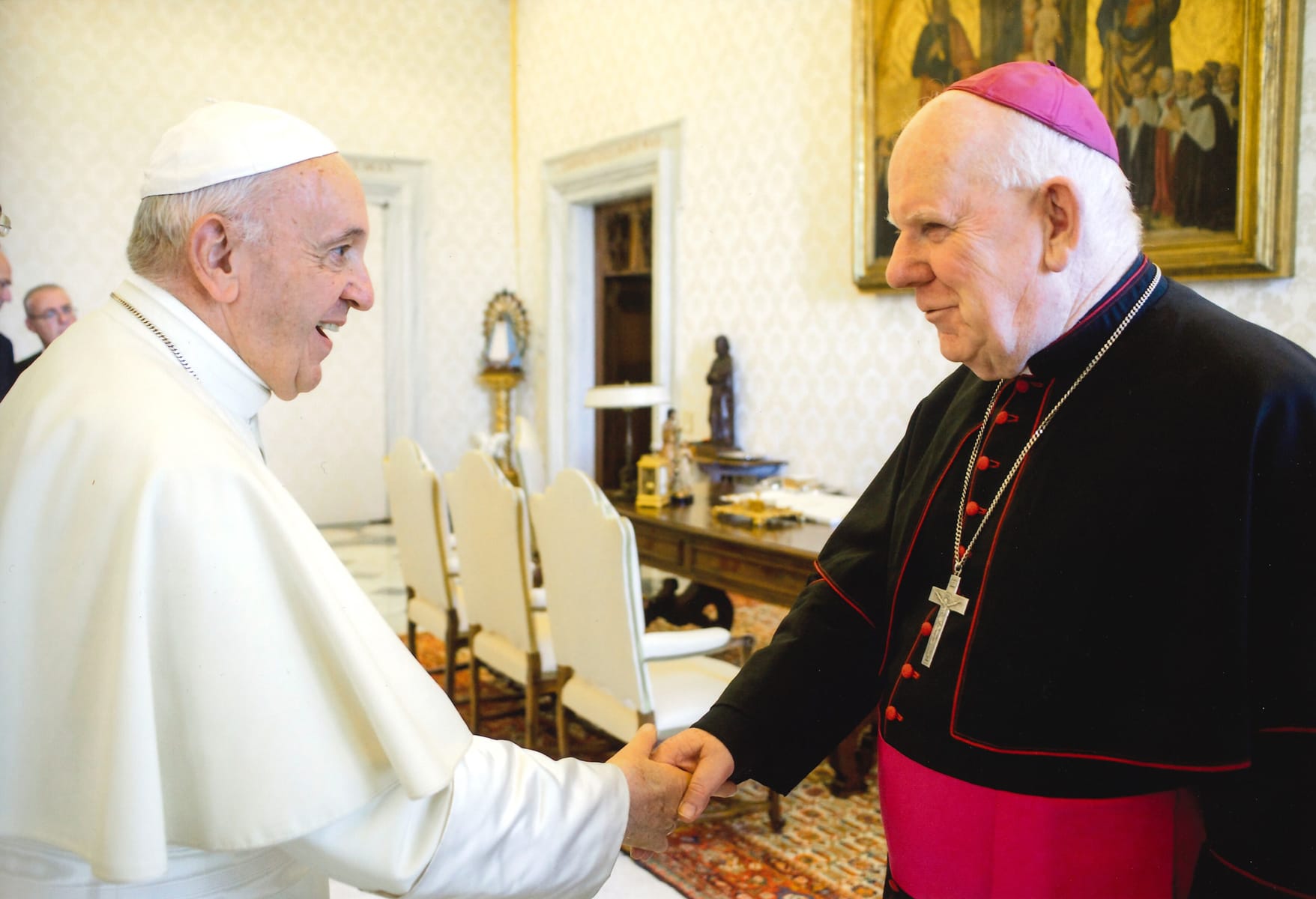
As you will have heard, last Friday night Western Australian time, Pope Francis accepted my resignation as Bishop of Bunbury, which was submitted nearly ten months ago. As parishioners 76 years old or older will appreciate, I have neither the health nor the energy to continue to be responsible for a Diocese that is more than half the size of Victoria.
Let us love both mother and unborn child
Dear Brothers and Sisters,Legislation was introduced into the Western Australian parliament this last week to make access to abortion easier. The aim is to facilitate the abortion of more unborn human beings than current legislation […]
How can we make the mass relevant?
There are many reasons why Catholics say that they have given up going to Mass. The two most consistent seem to be that ‘the Mass is boring’ and ‘the Mass is irrelevant to my life […]
Feast of the Body and Blood of the Lord
Reflections for a Time of Pandemic‘Do we really need the Eucharist?’Many over the past century have questioned: ‘Why do I need to go to Mass?’ They ask questions such as ‘Can’t I be a good […]
Trinity Sunday 2020
– Reflections for a Time of Pandemic – Trinity Sunday * ‘When Am I Truly Human?’ * Our enforced life style changes over nearly three months have caused many to pause, to be less […]
Pentecost Sunday 2020
– Reflections for a Time of Pandemic – * ‘Am I struggling right now without the Holy Spirit?’ * In these uncertain times, people are affected in many ways. Currently, there are programmes such as […]
Seventh Sunday of Easter 2020
Reflections for a Time of PandemicAm I truly at peace within? I doubt that anyone could claim these days that over recent decades, there has not been a decline both in religious practice, and a decline […]
Sixth Sunday of Easter 2020
– Reflections for a Time of Pandemic –Would our parishioners be arrested? In 250 AD, the Roman Emperor Decius instituted a persecution which caused considerable suffering to Christians. They were given the choice between worshipping Roman […]
Fifth Sunday of Easter 2020
– Reflections for a Time of Pandemic – Do We Seek Christ in Times of Loneliness? We are hearing of surveys which show there has been a rapid increase in loneliness and anxiety in […]
Forth Sunday of Easter 2020
Reflections for a Time of PandemicDo We Let Christ Love Us? A basic belief of our faith is the indescribable experience of being loved personally by the Risen Jesus. As long as we are experiencing this, we […]
Third Sunday of Easter 2020
– Reflections for a Time of Pandemic – *Do we Seek the Power of the Risen Jesus for Our Lives?* Daily life throws up many worries and challenges. These come from married and family […]
Second Sunday of Easter 2020
Easter Vigil 2020
MAKING SENSE OF DIFFICULT TIMES – Homilies for a Time of Pandemic – There are different understandings these days of what it means to be a Christian. Many, for example, mistakenly think of Christianity […]
Good Friday 2020
MAKING SENSE OF DIFFICULT TIMES- Homilies for a Time of Pandemic –‘I know that my Redeemer Lives’ Today, we celebrate Jesus taking the path he foretold he must take for the triumph of his Resurrection, namely […]
Mass of the Last Supper 2020
MAKING SENSE OF DIFFICULT TIMES- Homilies for a Time of Pandemic –* Christ empowers Christian love * One of the consequences of the regulations we now have to protect as many as possible from the coronavirus […]
PALM SUNDAY 2020
Mass Fifth Sunday in Lent 2020
Fifth Sunday of Lent 2020
MAKING SENSE OF DIFFICULT TIMES- Homilies for a Time of Pandemic – The quality of our lives is a common preoccupation of human beings. People look for happiness and keep modifying their daily lives in ways […]
Forth Sunday in Lent 2020
MAKING SENSE OF DIFFICULT TIMES- Homilies for a Time of Pandemic –* Fourth Sunday of Lent *To say that these are unsettling times is something of an understatement. In a country that seemed so secure, […]
What are the fruits of our 2019 Diocesan Synod?
Dear ParishionersLast June, our Diocese celebrated its first Synod as envisaged by the Second Vatican Council and encouraged by Pope Francis. The purpose of this Pastoral Letter is to share with all the fruits of […]
Bishop Gerard’s Pastoral Letter on Euthanasia
Dear Brothers and Sisters in ChristDuring this past week, the lower house of the Western Australian Parliament, the Legislative Assembly, voted to pass the draft legislation which would legalise euthanasia in our State. The draft […]
DECREE OF CONVOCATION
Dear Brothers and Sisters in Christ The Bunbury Diocese faces many challenges to its mission today, as does the Catholic Church in Australia. Our task is to proclaim Christ and his teachings in an increasingly […]
Cardinal Pell Pastoral Letter
Dear Parishioners and Parents of Students in Catholic Schools What a distressing week it has been after we all heard of the guilty verdict against Cardinal George Pell. I cannot remember such a national media […]
Who owns what in the Bunbury Diocese?
Dear Parishioners People have been asking me about possible implications for parishes and Catholic schools of legislation passed earlier this year related to payments to survivors of abuse. I have tried to answer their questions […]
Let us Share Our Lives with the Lord
Nothing in life compares with personal experiences of Christ. He is our Lord and Saviour. [1] Believers have suffered persecution, torture and death rather than risk losing these experiences. The gospels give numerous examples of […]
Launch of the Safeguarding Program and call for Safeguarding Officers
To the people of the Bunbury Diocese I wish to repeat again my most sincere apology of Christmas 2015 to all those who have suffered the horrors of child abuse within the Church, particularly in […]
Love for our gay brothers and sisters
Dear Brothers and Sisters in Christ Sadly, in the recent debate about gay marriage, many gay people – along with their parents, family members and friends – have been hurt by what they have been […]
An open letter to Parishioners and Parents of Catholic school students
Dear Parishioners and Parents of Catholic school students I am writing this letter because I am concerned about some confusion in relation to possible consequences for Catholic schools of a YES vote in the current […]
Why is Marriage between a man and a woman different?
For Catholics, marriage between a man and a woman is different from any other relationship. Therefore, the word ‘marriage’ should not be used for any other relationship. The reasons for saying that marriage is a […]
Statement regarding royal commission findings February 10th 2017
My dear people Who could not be shocked, horrified and disgusted to learn this past week of the scale of allegations of child abuse against priests, made by survivors who came forward to the Royal […]
Royal Commission Hearing #50
Dear brothers and sisters in Christ, I write to you as the final hearing involving the Catholic Church at the Royal Commission into Child Sexual Abuse commences on February 6, 2017. For the victims and […]
Are We Experiencing God’s Mercy?
The mercy of God can be a nice idea that leaves us with warm feelings. However, to be more than an idea, we need actually to be having experiences of God’s mercy. For the Old […]
Let Us Protect Parents’ Rights
I write to you again about the protection of our young people from internet porn intruding into their homes against their parents’ wishes. Currently, there is a battle between the Commonwealth Government and most pornographic […]
Let the Eucharist Change Us
Dear Sisters and Brothers in Christ In April last year, Pope John Paul II launched a world-wide renewal of Catholic belief and practices in the Eucharist. He published an Encyclical letter to all Catholics, Ecclesia […]
Am I prepared?
Death is one of the certainties of life. Jesus taught that we must always be prepared for our deaths [Matthew 25:13]: … because you do not know either the day or the hour The experience […]
Pastoral Letter 2015 – Let us reflect on our common home.
Our Holy Father, Pope Francis, has written a new encyclical about the environment, our common home with all other human beings and creatures, entitled ‘Praise be to you, Lord’. The Pope is calling for a […]
Pastoral Letter 2015 – Let us reflect on our common home.
Our Holy Father, Pope Francis, has written a new encyclical about the environment, our common home with all other human beings and creatures, entitled ‘Praise be to you, Lord’. The Pope is calling for a […]
The Vocation and Mission of the family in the Church and contemporary world Lineamenta
The Vatican has given Catholics around the world the opportunity to comment on the Lineamenta (or working document ) for the second Session of the Synod on marriage and the family in the context of […]
Pastoral Letter for those facing martyrdom
Brothers and Sisters in Christ This letter is to ask every Catholic in the Bunbury Diocese to consider praying for our Christian brothers and sisters facing martyrdom at present around the world. Pope St John […]
Marriage law needs to reflect reality
Currently there is to be a plebiscite about whether the Commonwealth Parliament should deny in law that marriage between a man and a woman is a distinctive relationship needing a distinctive name. The proposal is to apply the word ‘marriage’ also to relationships between same sex couples. However, while Parliament has the power to pass such a law, it has no power to change the reality
Pastoral Letter for those facing martyrdom
Brothers and Sisters in Christ This letter is to ask every Catholic in the Bunbury Diocese to consider praying for our Christian brothers and sisters facing martyrdom at present around the world. Pope St John […]
Pastoral statement on the need to care for abused victims
Dear Sisters and Brothers in Christ We have all been shocked and appalled by revelations over the last week to the Royal Commission Inquiry into the responses of Australian institutions to child sex abuse. We […]
Pastoral statement on the need to care for abused victims
Dear Sisters and Brothers in Christ We have all been shocked and appalled by revelations over the last week to the Royal Commission Inquiry into the responses of Australian institutions to child sex abuse. We […]
How close is my personal relationship with Jesus?
ADVENT PASTORAL LETTER How close is my personal relationship with Jesus?
How close is my personal relationship with Jesus?
ADVENT PASTORAL LETTER How close is my personal relationship with Jesus?
Christ and a growing rural addiction
Christ and a growing rural addiction
The Royal Commission into Child Sex Abuse
This week, the Prime Minister, Julia Gillard, announced that a Royal Commission will be established into the sexual abuse of children across Australia. Though terms of reference are yet to be announced, this Royal Commission […]
At What Age Confirmation
The introduction of Middle Schooling in our schools is raising questions about when the Sacrament of Confirmation should be celebrated. To date, this sacrament has been conferred in Year Seven. We now have an opportunity […]
A Controversial Question : The Ordination of Women
A current controversial media question is Catholic teaching on the ordination of women to the priesthood. This is associated with the reported allegation by a university lecturer that Archbishop Hickey was not consistent in speaking […]
Preparing to Experience Christ Through The Mass
Over the past two thousand years, the Mass has been the most powerful means of drawing upon the power of Jesus Christ, the Son of God, for the needs of people’s lives. The greatest means […]
What face do I show others?
How others see us is a common concern. We try in various ways to make a good impression. We try to present ‘our good side’ through words and behavior.
Same Sex Marriage
Marriage has been recognised as a special relationship between a man and a woman that is open to children since before recorded history. It has been recognised across all known human cultures as a relationship […]
So your sister is gay…
In the current debate about the legal definition of marriage, questions have been raised about Catholic teaching on homosexuality. There seems to be considerable confusion.
Remembering to Love Our Deceased
Everyone has loved ones – family members and friends – who have died. November is the month when Catholics show love for their loved ones by praying for their eternal rest. Why do we do […]
Revisioning Catholic Schools in an Education Revolution
REVISIONING CATHOLIC SCHOOLS IN AN EDUCATION REVOLUTION – Directors of Catholic Education Conference – Bishop Gerard Holohan (Sydney, 23 April 2009) I begin my comments by expressing thanks to you, the leaders of our Australian […]
Two Changes to the Ritual of the Mass
On Pentecost Sunday, two minor changes will be introduced into the celebration of the Mass across Australia. These changes are the result of the review of the ritual of the Mass undertaken at the direction […]
Sharing the Eucharist with Others
If I could believe that Jesus is present in the Eucharist, I would crawl over broken glass if necessary to be with him. These are the words of a minister from another Christian church to […]
Pastoral Letter – Are We Finding Jesus in the Eucharist?
Christian faith first and foremost is based upon a personal relationship with Jesus Christ, the Son of God. St Paul spoke of the experience of early Christians when he proclaimed that the greatest of all […]
Australia Day 2009: Pastoral Statement
Each Australia Day invites us to reflect upon how well we are living our shared national values. My reflection this year is on how to support parents who are trying to protect our young from […]
The Good Shepherd of Sunday 2004 – Let us pray for more priests
The image of Jesus as the Good Shepherd is an important one for our faith. It reminds us that, though he died for the whole human race, Jesus does not see us simply as a […]
The Australian Need for New Evangelisation
I am delighted to have this opportunity to speak to you, the religious education leaders within the Catholic school systems from all the dioceses across Australia. In doing so, I also acknowledge the formidable challenges […]
Preparing to experience Christ through the Mass
Over the past two thousand years, the Mass has been the most powerful means of drawing upon the power of Jesus Christ, the Son of God, for the needs of people’s lives. The greatest means […]
Message 2006 – Nurturing the Catholicity in our Catholic Schools
For many obvious reasons, the question of how to nurture the catholicity of our schools today is a vital one. The task that I have been given is to reflect upon this question from the […]
Message 2006 – Let us Respect our Australian Values
Australia is a nation that loves celebrations. Australia Day is one of our biggest. We get together for ceremonies, including the raising of our national flag and to welcome new citizens.
Where is the Spirit Leading the Bunbury Diocese?
Pastoral Letter to the People and Decision Makers in the Diocese of Bunbury Dear brothers and sisters in Christ
Good Shepherd Sunday Statment – 2005
Today, we celebrate Good Shepherd Sunday. In today’s Gospel, we remember the words of Jesus [John 10:11-12]:
Lenten Pastoral Letter 2004 – Do they recognise us by our Love?
Dear Brothers and Sisters in Christ This is our Golden Jubilee Year as a diocese, established by Pope Pius XII in November 1954.
Santa Maria Mission Pilgrimage 2004
17 April 2004 We gather for this, the first of our diocesan Golden Jubilee liturgical events, on what is, for us, holy ground – the site of the first mission within the area of the […]
Golden Jubilee Mass Homily 2004
A jubilee is a celebration. A Church jubilee is always a celebration of the blessings of God. A diocesan celebration is a celebration of God’s blessings, received through the ministry of Christ, in the parish […]